


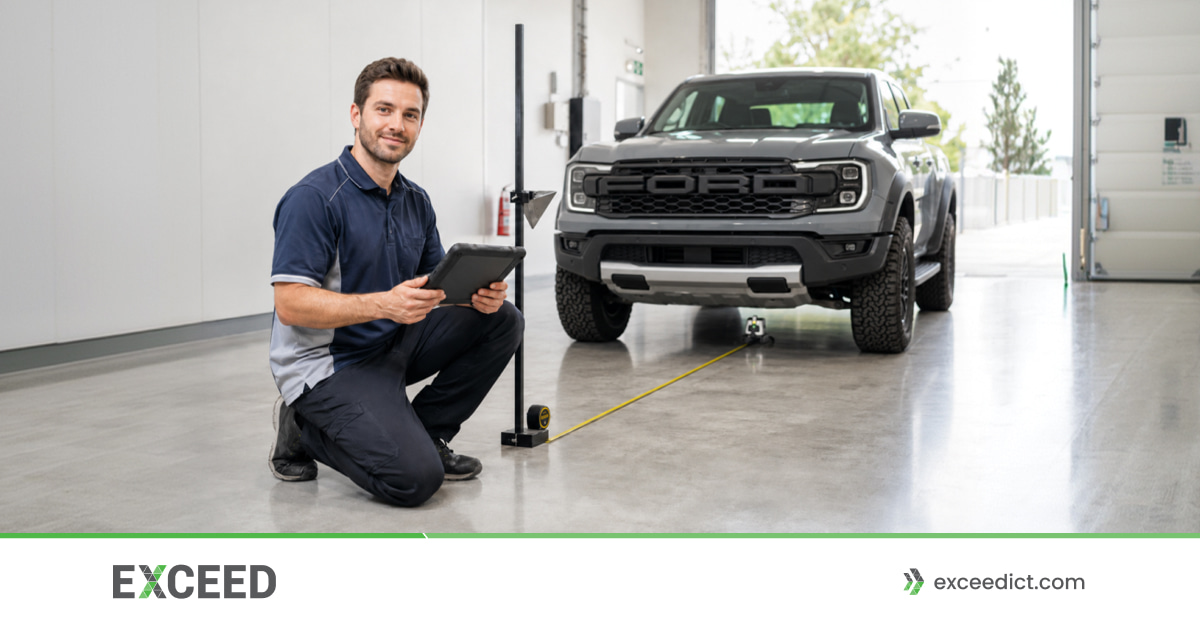
Modern vehicles are equipped with sophisticated Advanced Driver Assistance Systems (ADAS) that help drivers detect hazards, maintain lanes and respond to changing road conditions. These systems depend on cameras, radar and other sensors that must be accurately positioned and correctly configured to operate as intended. ADAS calibration services Brisbane help restore these systems to the vehicle manufacturer’s required specifications using specialist diagnostic equipment, calibration targets and, where required, controlled road testing.
For Brisbane drivers, fleet operators, automotive repairers and collision repair businesses, understanding when calibration is needed and how the process works is an important part of modern vehicle safety.
What Is ADAS Calibration?
ADAS calibration is the process of accurately aligning, aiming, configuring or relearning the cameras, radar sensors and other components used by a vehicle’s driver assistance systems.
These systems can support features such as:
- Autonomous Emergency Braking (AEB)
- Lane Keep Assist
- Lane Departure Warning
- Adaptive Cruise Control
- Forward Collision Warning
- Traffic Sign Recognition
- Blind Spot Monitoring
- Rear Cross-Traffic Alert
- Surround-view camera systems
- Parking assistance
The calibration process varies significantly between vehicle manufacturers and models. Technicians must follow the relevant manufacturer procedures, measurements and diagnostic requirements rather than applying one universal calibration method.
Why Is ADAS Calibration Important?
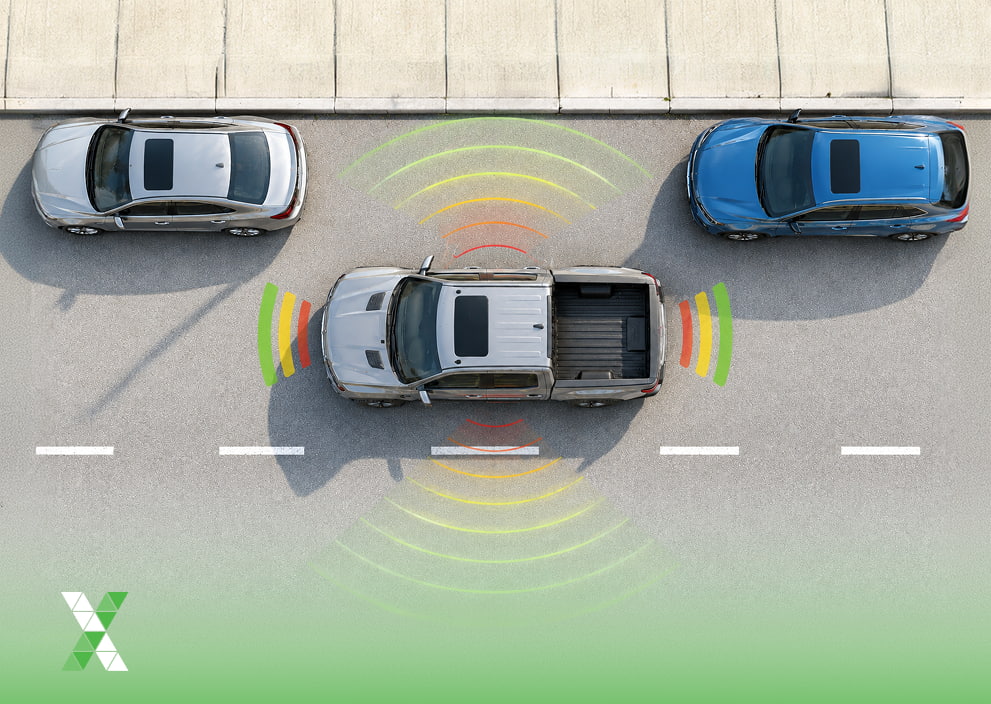 ADAS technology relies on accurate information about the vehicle’s surroundings. Cameras and radar sensors need to understand the vehicle’s position relative to lanes, vehicles, pedestrians and other objects.
A sensor that has moved from its intended position can affect the information being supplied to the vehicle’s electronic control systems. Depending on the system and fault, this may result in warning messages, system deactivation or inaccurate operation.
Proper calibration helps ensure that the relevant ADAS functions operate according to the vehicle manufacturer’s specifications. Calibration is therefore not simply a software reset. It can involve precise physical measurements, sensor aiming, diagnostic procedures and road testing.
When Does a Vehicle Need ADAS Calibration?
ADAS calibration may be required after a range of common vehicle repairs and maintenance procedures.
Windscreen Replacement
Many vehicles have a forward-facing camera mounted near the top of the windscreen. This camera may support lane detection, forward collision warning, traffic sign recognition and autonomous emergency braking.
Replacing the windscreen can change the camera’s position relative to the vehicle. If calibration is specified by the manufacturer after glass replacement, it should be completed before relying on the affected safety systems.
Collision and Accident Repairs
Even relatively minor collisions can affect sensor mounting points, bumper components, grilles or body panels. A front-end impact may affect a radar sensor, while damage to another part of the vehicle could influence camera or blind-spot sensor positioning.
A diagnostic inspection and calibration assessment should therefore form part of appropriate collision repair procedures where ADAS components may have been affected.
Wheel Alignment
Wheel alignment changes the vehicle’s relationship with the road. Some ADAS systems rely on accurate vehicle geometry and steering information. After alignment work, technicians may need to check whether the vehicle’s ADAS systems require additional calibration or related procedures according to the manufacturer’s instructions.
Suspension Repairs or Modifications
Suspension components influence vehicle ride height, pitch and overall geometry. Replacing suspension components or making modifications can therefore affect sensor positioning. Depending on the vehicle, an ADAS calibration or related relearning procedure may be required.
Camera or Radar Replacement
A damaged camera, radar unit or sensor may need to be replaced following an accident or component failure. Installing the replacement component does not necessarily mean the system is ready to operate. The vehicle may require programming, initialisation, aiming and calibration using manufacturer-specific procedures.
Sensor or Component Disconnection
Some repairs require ADAS components to be disconnected or removed temporarily. Depending on the vehicle and system, this can trigger diagnostic faults or require an initialisation or calibration procedure after reassembly.
Main Types of ADAS Calibration
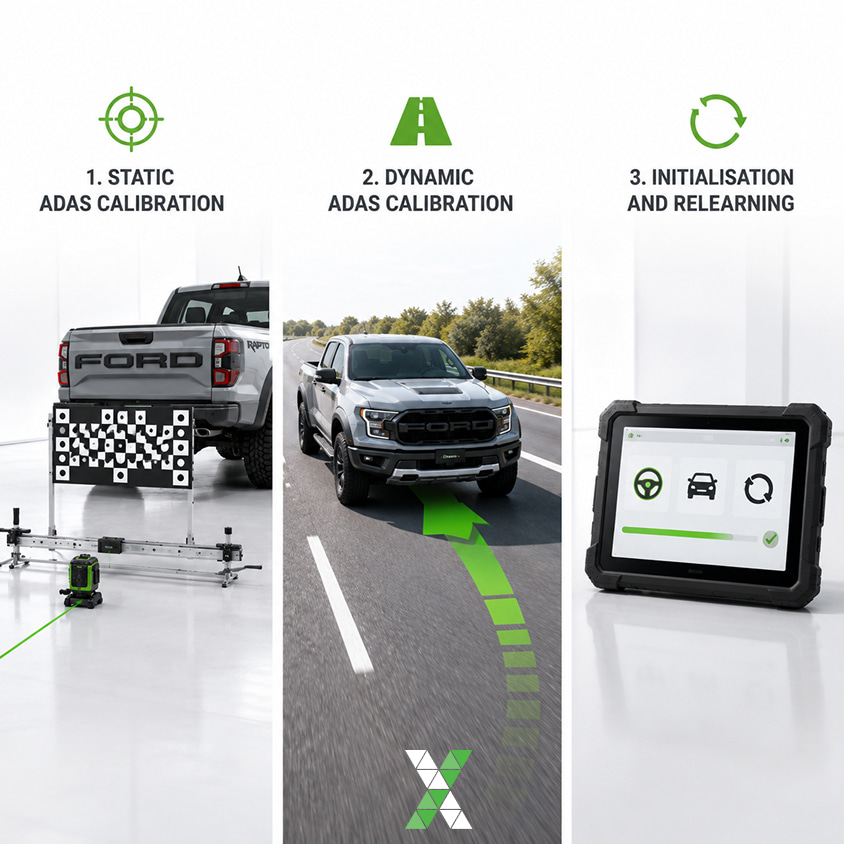 There are several calibration and relearning procedures used across modern vehicles. The appropriate method depends on the vehicle manufacturer, model, sensor and ADAS technology.
Static ADAS Calibration
Static calibration is performed in a controlled workshop environment.
Technicians use specialised targets positioned at precise distances, heights and angles relative to the vehicle. Diagnostic equipment communicates with the vehicle to initiate and complete the calibration procedure.
Static calibration can require:
- A level workshop floor
- Accurate vehicle positioning
- Manufacturer-specific calibration targets
- Laser or digital measurement equipment
- Appropriate lighting conditions
- Sufficient working space
- Compatible diagnostic software
Small measurement errors can affect the calibration, which is why controlled workshop conditions are important.
Dynamic ADAS Calibration
Dynamic calibration is performed while driving the vehicle under specified road conditions.
A diagnostic scan tool may place the relevant system into a calibration or learning mode. The vehicle is then driven according to the manufacturer’s requirements so the system can recognise road markings, traffic conditions or other environmental references.
Dynamic calibration may require:
- Clearly visible lane markings
- Suitable road conditions
- Appropriate weather
- Specified driving speeds
- Sufficient uninterrupted driving distance
- A compatible diagnostic scan tool
Not every vehicle uses dynamic calibration, and some vehicles require a combination of static and dynamic procedures.
Initialisation and Relearning
Some ADAS-related procedures involve initialising or relearning sensors and electronic components. This can include steering angle resets, sensor parameterisation, system relearning or programming following component replacement.
Initialisation should not automatically be treated as a substitute for physical calibration. The required procedure depends on the manufacturer’s technical specifications.
Which ADAS Components May Require Calibration?
Modern vehicles can contain multiple sensors working together.
Forward-Facing Cameras
Forward-facing cameras are commonly positioned behind or near the windscreen.
They can support:
- Lane Keep Assist
- Lane Departure Warning
- Traffic Sign Recognition
- Forward Collision Warning
- Autonomous Emergency Braking
Radar Sensors
Radar units are often positioned behind the front grille, bumper or other body components.
They can provide information used by systems such as:
- Adaptive Cruise Control
- Autonomous Emergency Braking
- Forward Collision Warning
- Blind Spot Monitoring
Surround-View Cameras
Multiple cameras may be positioned around the vehicle to create a 360-degree view. These cameras can support parking assistance, manoeuvring and driver visibility.
Ultrasonic Sensors
Ultrasonic sensors are commonly associated with parking assistance and proximity detection. Their calibration requirements vary by manufacturer and vehicle system.
LiDAR and Other Sensors
Some advanced vehicles use additional sensing technologies, including LiDAR or other specialised sensors. Calibration requirements depend on the specific vehicle architecture.
What Happens During an ADAS Calibration Service?
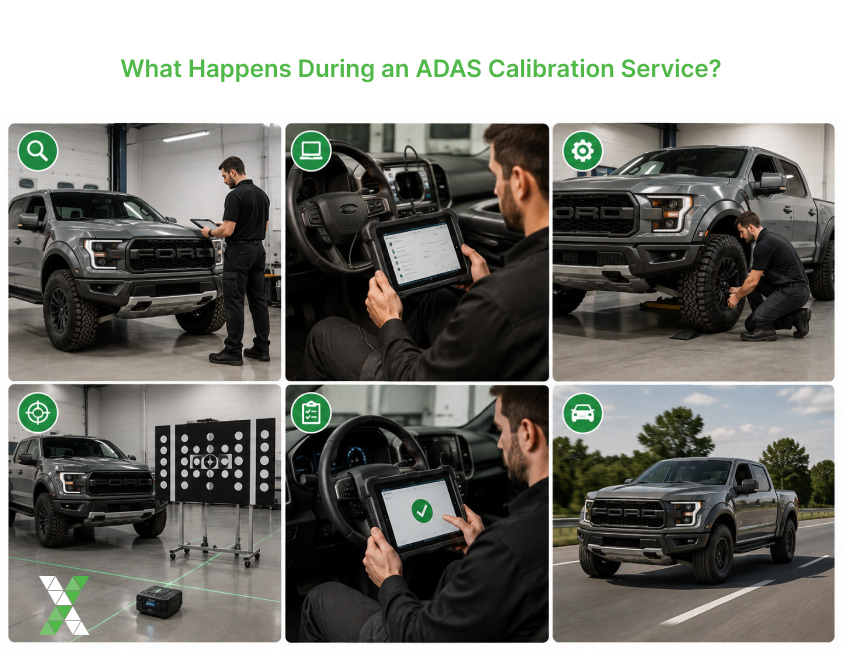 A professional calibration process generally follows several stages.
Step 1: Vehicle Inspection
The technician identifies the vehicle’s make, model, year and relevant ADAS features. They assess whether recent repairs or component changes could have affected sensor positioning.
Step 2: Diagnostic Pre-Scan
A compatible diagnostic tool can be used to check the vehicle’s electronic systems before calibration. This helps identify existing diagnostic trouble codes and provides a baseline for the calibration process.
Step 3: Vehicle Preparation
The vehicle may need to meet specific manufacturer conditions before calibration.
Depending on the vehicle, technicians may check:
- Tyre pressures
- Wheel alignment
- Steering wheel position
- Ride height
- Fuel or vehicle load requirements
- Battery voltage
- Sensor and camera cleanliness
The exact requirements vary between manufacturers.
Step 4: Calibration
The technician performs the required static, dynamic or combined calibration procedure. For static calibration, targets are carefully positioned using the manufacturer’s specified measurements.
For dynamic calibration, the vehicle is driven under the required road and environmental conditions.
Step 5: Post-Calibration Diagnostics
A final diagnostic scan can confirm whether relevant faults remain and whether the calibration procedure has completed successfully.
Step 6: Road Test and Verification
Where required, a controlled road test can verify the vehicle’s systems under appropriate conditions. Documentation of the calibration and diagnostic results can also be retained as part of the vehicle’s repair records.
ADAS Calibration After Windscreen Replacement
Windscreen replacement is one of the most common reasons drivers encounter ADAS calibration requirements. If a forward-facing camera is mounted to or positioned relative to the windscreen, changing the glass can alter the camera’s alignment.
Before replacing a windscreen, vehicle owners should ask the repairer whether their vehicle requires ADAS calibration after the replacement.
A suitable service provider should be able to identify the vehicle’s calibration requirements and explain whether static, dynamic or another manufacturer-specified procedure is required.
ADAS Calibration for Collision Repair
Collision repair has become more complex as vehicles incorporate more cameras and sensors. A bumper repair that appears cosmetic may involve a radar sensor positioned behind the bumper. Similarly, structural repairs can change the vehicle geometry that ADAS systems rely on.
For this reason, collision repair businesses increasingly need processes for identifying ADAS components, performing diagnostic scans and determining whether calibration is required after repairs.
Choosing ADAS Calibration Services in Brisbane
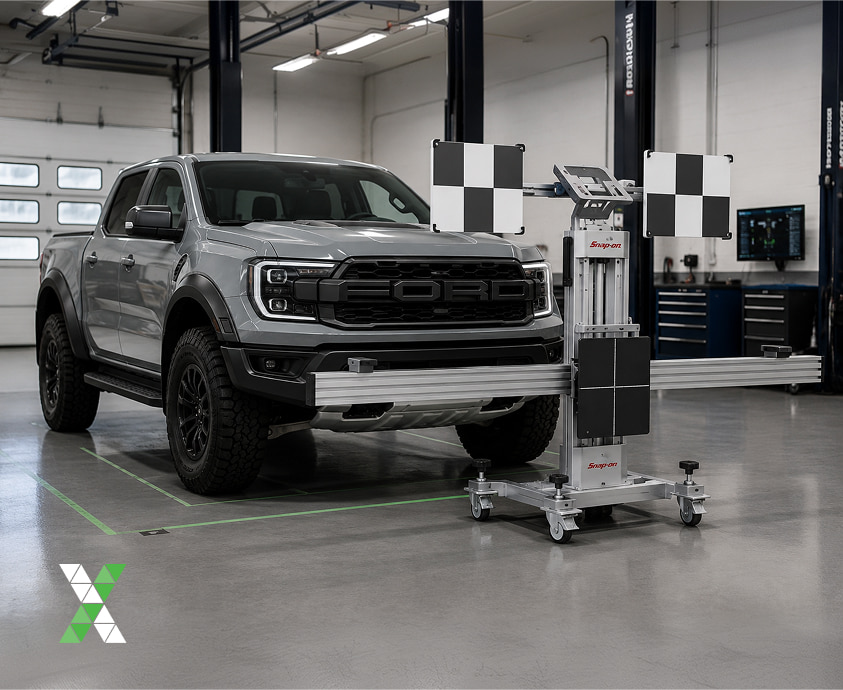 When comparing ADAS calibration services Brisbane, consider more than location and price.
- Manufacturer Coverage: Ask whether the provider has the appropriate diagnostic software, calibration targets and technical information for your vehicle.
- Calibration Equipment: Professional calibration requires more than a generic diagnostic scanner. Depending on the vehicle, technicians may need specialist targets, measurement systems and manufacturer-specific tools.
- Diagnostic Capability: A provider should be able to perform appropriate pre- and post-calibration diagnostics.
- Static and Dynamic Capability: Ask whether the provider can perform the calibration method required by your specific vehicle.
- Documentation: Request documentation showing what procedure was performed and whether the calibration was completed successfully.
- Mobile Capability: If you need on-site service, confirm that the vehicle and calibration procedure are suitable for mobile work.
Why OEM Procedures Matter
There is no single calibration procedure that applies to every vehicle. Different manufacturers can specify different target dimensions, measurement tolerances, driving conditions, diagnostic sequences and system requirements.
Following the appropriate manufacturer procedure helps reduce the risk of incorrect calibration. For this reason, technicians should identify the exact vehicle and ADAS system before starting the calibration process.
ADAS Calibration and Vehicle Safety
ADAS technologies are designed to assist drivers, but they depend on accurate sensor data. Calibration should therefore be treated as an important safety-related procedure rather than a routine software reset.
If your vehicle has undergone a windscreen replacement, collision repair, wheel alignment, suspension work or sensor replacement, ask whether an ADAS inspection or calibration is required. Do not assume that the absence of a dashboard warning means the system does not require attention.
ADAS Calibration Services in Brisbane
Brisbane drivers, automotive workshops, fleet operators and collision repair businesses can access specialist ADAS calibration solutions through dedicated centres and mobile service providers.
EXCEED ICT can support businesses requiring ADAS-related technology and vehicle connectivity solutions, depending on their specific operational requirements.
Before booking a calibration service, provide the technician with the vehicle’s make, model and year, along with details of any recent repairs. This allows the provider to determine the appropriate calibration requirements.
Need ADAS calibration support in Brisbane? Contact EXCEED ICT to discuss your vehicle calibration and connected vehicle requirements.
Call us on 1300 832 639 or simply search “Exceed ICT” on Google Maps to find a location near you and connect with our team today.
We also provide Managed Services, Asset Management, IoT Helpdesk, Fleet Management, Project Management, Telecoms Expense Management.
Improve Your Business Core values, Business Consulting, Network Management, Telstra Adaptive Mobility, Device Enrolment, and many more Solutions.
Find us (Exceed ICT) on Google map.
Frequently Asked Questions
How long does ADAS calibration take?
The time varies depending on the vehicle, sensor configuration and calibration method. Static calibration can take longer when extensive setup and measurement are required, while dynamic calibration depends on the required driving procedure.
Is ADAS calibration required after every windscreen replacement?
Not necessarily for every vehicle, but many vehicles with windscreen-mounted cameras have specific calibration requirements after glass replacement. The vehicle manufacturer’s procedure should be checked.
Can ADAS calibration be performed at my location?
Some calibration procedures can be completed through mobile services. However, static calibration may require a controlled environment with sufficient space, level flooring and specialised equipment.
Does wheel alignment affect ADAS?
It can. Changes to wheel alignment, steering geometry or vehicle stance may affect systems that depend on accurate vehicle geometry. The manufacturer’s requirements should be checked after alignment or suspension work.
What is the difference between static and dynamic calibration?
Static calibration uses physical targets in a controlled workshop environment. Dynamic calibration uses a specified road drive cycle to allow the vehicle’s systems to learn from real-world road conditions.
Get Professional ADAS Calibration Support in Brisbane
Accurate ADAS calibration helps ensure that cameras, radar and other safety sensors are correctly aligned and configured following relevant repairs or maintenance.
Whether you need calibration after a windscreen replacement, collision repair, wheel alignment or sensor replacement, choose a provider with the appropriate diagnostic equipment, calibration technology and vehicle-specific expertise.