


LEO satellite internet is changing how organisations approach connectivity by using satellites positioned much closer to Earth than traditional geostationary satellites. This technology can provide lower communication latency, responsive data transmission and network access in locations where terrestrial infrastructure is limited.
For Australian Business, Enterprise and Government organisations, understanding how Low Earth Orbit (LEO) satellite technology works can help identify new opportunities for remote connectivity, operational efficiency and network resilience.
What Is LEO Satellite Internet?
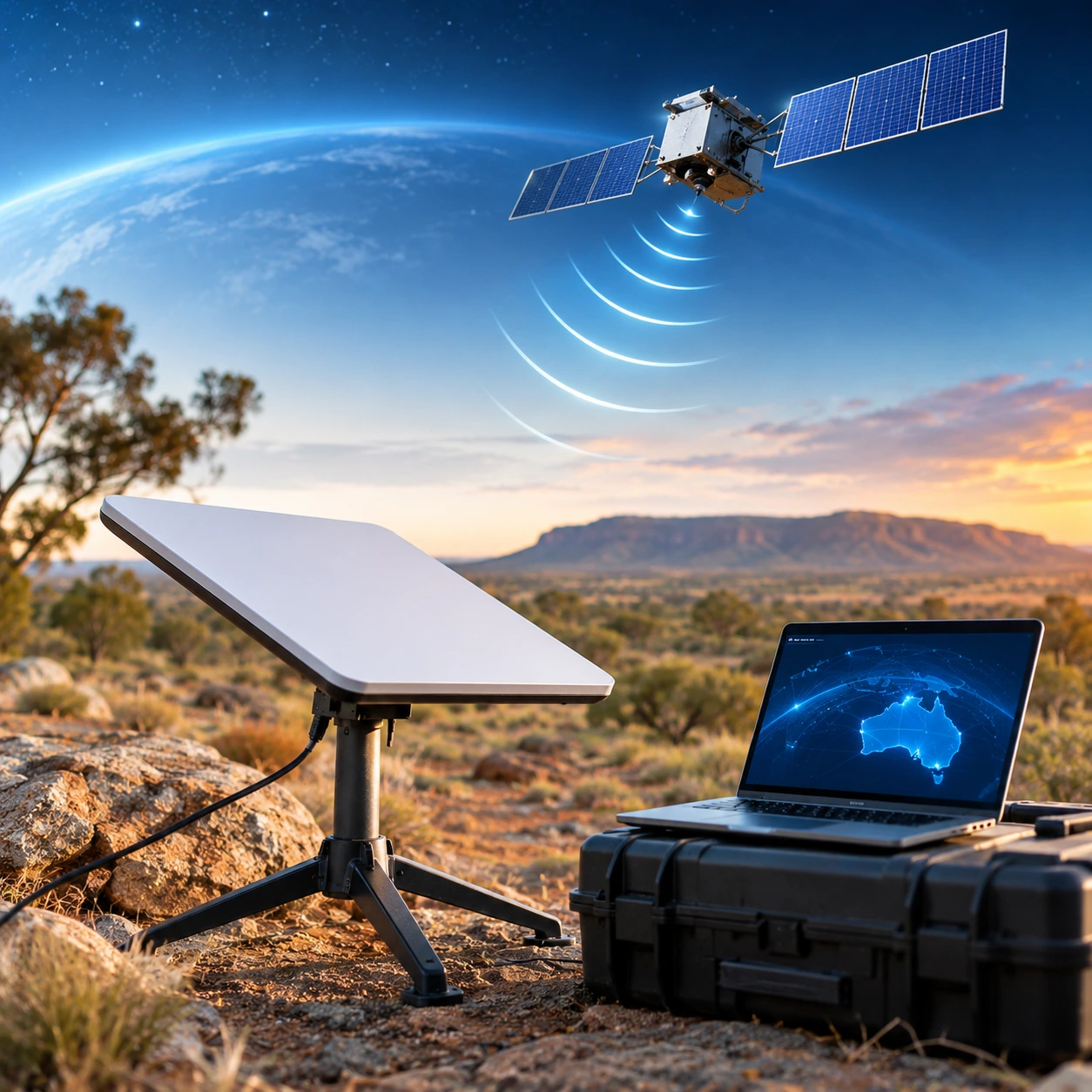 LEO satellite internet uses networks of satellites orbiting approximately 160 to 2,000 kilometres above Earth’s surface to deliver broadband connectivity. Traditional geostationary satellites operate approximately 35,786 kilometres above Earth. Their greater distance increases the time required for signals to travel between the ground and space.
LEO satellites operate much closer to the planet, reducing signal travel distance and generally delivering lower latency.
Unlike traditional satellite systems that can rely on a small number of satellites in fixed orbital positions relative to Earth, LEO networks use coordinated constellations of fast-moving satellites. These satellites work together to provide communication coverage across large geographical areas.
For enterprises operating remote facilities, infrastructure projects and mobile workforces, this technology offers another way to extend network connectivity beyond conventional telecommunications infrastructure.
How Does LEO Satellite Internet Work?
LEO satellite internet relies on several interconnected technologies working together to transmit data between ground equipment, satellites and the wider internet.
The process involves three main components: satellite terminals, orbital constellations and ground infrastructure.
Satellite Terminals and Phased Array Antennas
A satellite terminal is the equipment installed at a business location, remote facility or approved mobile platform to communicate with satellites overhead.
Many modern LEO systems use electronically steered phased array antennas. Unlike conventional satellite dishes that point towards a fixed orbital position, these antennas can electronically direct communication signals towards moving satellites.
This allows the terminal to maintain communication as satellites travel across the sky.
For enterprise deployments, terminals must be selected according to the operating environment, coverage requirements, mounting arrangements and network compatibility.
Satellite Constellations and Network Handovers
LEO satellites travel around Earth at high speeds, typically completing an orbit in approximately 90 to 120 minutes, depending on their altitude.
Because individual satellites move continuously, one satellite cannot provide uninterrupted coverage to a fixed location on its own.
LEO networks therefore use coordinated satellite constellations. As one satellite moves out of range, another can take over the communication connection.
This process is known as a satellite handover. Network management systems coordinate these transitions to help maintain ongoing connectivity.
Some modern satellite networks also use inter-satellite laser links, allowing data to travel between satellites before reaching a ground station. This can provide additional routing flexibility across the network.
Ground Stations and Data Transmission
Ground stations, also known as gateways, connect satellite networks to terrestrial communications infrastructure.
When a user accesses a business application, sends information or joins a video conference, the data travels from the satellite terminal to a satellite overhead.
Depending on the network architecture, the satellite may relay the information to a ground gateway or pass it through other satellites using inter-satellite links.
The data then travels through the wider network to reach its destination. The response follows the appropriate return communication path.
This combination of satellite infrastructure and terrestrial networks enables LEO systems to provide internet connectivity across geographically dispersed locations.
Why Does LEO Satellite Internet Have Lower Latency?
 Latency refers to the time required for data to travel between two points and for a response to return. One of the main advantages of LEO satellite technology is its relatively low orbital altitude. Because LEO satellites operate much closer to Earth than geostationary satellites, the distance travelled by communication signals is significantly shorter.
Traditional geostationary satellite services can experience round-trip latency of approximately 550 to 650 milliseconds or more, depending on the network.
LEO satellite networks can often achieve latency in the range of approximately 20 to 60 milliseconds under suitable conditions. Actual performance varies depending on network design, routing, congestion and operating conditions.
Lower latency can support enterprise applications such as:
- Cloud-based business platforms.
- Video conferencing and voice communications.
- Remote system access.
- Operational monitoring and reporting.
- Virtual private networks (VPNs).
- Connected vehicle and IoT applications.
This makes LEO satellite connectivity a useful option for organisations that need responsive communications in remote environments.
LEO Satellite vs Traditional GEO Satellite Connectivity
Both Low Earth Orbit (LEO) and Geostationary Earth Orbit (GEO) satellites provide communication services, but their orbital positions and network architectures differ.
| Feature | LEO Satellite | GEO Satellite |
| Orbital altitude | Approximately 160–2,000 km | Approximately 35,786 km |
| Orbital movement | Moves rapidly around Earth | Appears stationary relative to a ground location |
| Network architecture | Coordinated satellite constellations | Typically fewer satellites covering larger areas |
| Latency | Generally lower | Generally higher |
| Satellite handovers | Required as satellites move | Not normally required for a fixed connection |
| Enterprise applications | Remote connectivity, mobile operations and responsive data services | Remote communications and applications less sensitive to latency |
The most appropriate technology depends on an organisation’s location, coverage requirements, application performance needs and overall network strategy.
LEO Satellite Connectivity in Australia
Australia’s large geographical area and widely distributed regional industries create significant connectivity challenges. Mining sites, agricultural operations, transport networks, infrastructure projects and government facilities may operate in locations where fibre and mobile network coverage are limited.
LEO satellite technology provides another connectivity option for these environments.
For Australian enterprises, potential applications include:
Mining and Resources
Remote mining operations depend on reliable communication between field teams, equipment and central management systems. LEO satellite connectivity can support operational data transmission, remote access, connected equipment and communications across isolated sites.
Government and Emergency Services
Government agencies and emergency response organisations may require communications in remote locations or during situations where terrestrial networks are unavailable or disrupted. Satellite connectivity can provide an additional communications pathway for remote facilities, emergency coordination and mobile command environments.
Construction and Infrastructure
Large infrastructure projects frequently operate across temporary or geographically isolated sites. LEO satellite connectivity can help establish network access for project management platforms, communications, monitoring systems and connected equipment.
Agriculture and Regional Operations
Agricultural organisations often manage assets and teams across extensive areas. Satellite connectivity can support remote monitoring, IoT devices, operational reporting and communication between field teams and central offices.
Transport and Logistics
Transport and logistics organisations require connectivity to coordinate vehicles, personnel and operational systems. Suitable LEO satellite solutions can extend communication capabilities to selected mobile environments, subject to equipment and service requirements.
Key Considerations for Enterprise LEO Satellite Deployment
Although LEO satellite technology offers significant connectivity opportunities, organisations should assess several factors before implementing a solution.
- Coverage and Availability: Confirm that the selected satellite network supports the required Australian operating locations.
- Equipment Compatibility: Choose satellite terminals and antennas that meet the organisation’s installation, environmental and operational requirements.
- Network Integration: Assess how satellite connectivity will work alongside existing WAN, SD-WAN, mobile broadband and cloud infrastructure.
- Power and Infrastructure: Remote installations may require suitable power systems, mounting arrangements and environmental protection.
- Security: Apply appropriate encryption, access controls, network segmentation and monitoring to protect business communications.
- Performance Requirements: Evaluate latency, bandwidth, network availability and service priorities according to the applications being supported.
A well-designed deployment should consider satellite connectivity as part of the wider enterprise network rather than treating it as an isolated service.
Enterprise LEO Satellite Connectivity with EXCEED ICT
 EXCEED ICT supports Business, Enterprise and Government organisations with connectivity, mobility, IoT and managed technology solutions across Australia.
For organisations operating in remote or geographically challenging environments, LEO satellite connectivity can form part of a broader enterprise network strategy.
By combining satellite connectivity with mobile networks, wireless WAN, IoT platforms and network management technologies, organisations can develop solutions that better support their operational requirements.
EXCEED ICT can assist with:
- Enterprise connectivity planning and consultation.
- Remote-site and fixed-location connectivity solutions.
- Mobile and field operations connectivity.
- Integration with existing network infrastructure.
- IoT and connected asset solutions.
- Managed connectivity and ongoing technical support.
Whether your organisation manages remote infrastructure, distributed operations or critical business services, EXCEED ICT can help identify suitable connectivity technologies for your environment.
Conclusion
LEO satellite internet is creating new opportunities for Australian organisations that need connectivity beyond the reach of traditional telecommunications infrastructure.
By operating closer to Earth, LEO satellites can deliver lower latency than traditional geostationary systems while coordinated satellite constellations provide coverage across extensive geographical areas.
For Business, Enterprise and Government organisations, this technology can support remote operations, connected infrastructure, mobile teams and network resilience. As satellite networks continue to evolve, LEO connectivity is becoming an increasingly relevant component of enterprise communications strategies.
Contact EXCEED ICT on 1300 832 639 to discuss enterprise connectivity requirements and explore solutions for remote and distributed operations across Australia.
Simply search “Exceed ICT” on Google Maps to find a location near you and connect with our team today.
We also provide Managed Services, Asset Management, IoT Helpdesk, Fleet Management, Project Management, Telecoms Expense Management.
Improve Your Business Core values, Business Consulting, Network Management, Telstra Adaptive Mobility, Device Enrolment, and many more Solutions.
Find us (Exceed ICT) on Google map.